
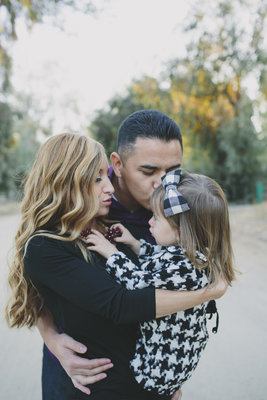
 As some of you might know, my toddler was diagnosed with a food allergy at around 10 months. Turns out she’s severely allergic to eggs. When I mean severely allergic, I mean she can go into anaphylactic shock, which affects body systems, which can lead to death. So how did we find out about her allergy, you ask?
At Mia’s 9-month check-up, the pediatrician mentioned that we should introduce her to a new type of food daily as opposed to several foods all at once. This was to rule out any type of food allergy. Well, thankfully, we followed these instructions to the ‘T’. At 10 months, I boiled an organic egg and just gave her a tiny piece to try. Within a couple of minutes, she was puking her little a$# off. I’m talking about projectile vomiting, followed by hives, and having a hard time breathing! I was home alone and began to panic. I didn’t know how to handle the situation. After all, I was a first-time mom. And by the way, why aren’t there any parent classes on this?!
So there I was, freaking out, and I called my husband at work. He said, “Well, if you gave her eggs, it must be that. Rush her to Urgent Care now!” Freaking out about the whole thing, I hurried along trying to gather the diaper bag with all her essentials. I was worried and cried most of the way to the UC. By the way, I can’t believe I didn’t call 911! I kept talking to Mia throughout the entire time and the car ride to ensure she was ok. She looked pale and lethargic but seemed to open her eyes slowly.
As soon as we got to the UC, I jumped out of the car and took her out of her car seat. I grabbed her bag and literally ran into the offices. I told a nurse what had just happened, and they rushed us into a room. A doctor on call came to the room immediately and checked her. He said, “She definitely has symptoms of a food allergy, but we need to get blood work done immediately to confirm.” My heart sank. Blood work? She’s so little! Yes, she had blood work done on her heel when she was a newborn to ensure she was not diabetic (I had gestational diabetes throughout my pregnancy). But there I was crying along with my baby at the time, as they held her down and drew her blood. Mind you, they drew it as if she were an adult. I kept thinking this is not real. This is not happening. This is just a bad dream, right? No one in our family is allergic to eggs or anything else, for that matter. Surely this is a mistake.
It was no mistake. I recall the doctor telling me that the lab work results confirmed she was severely allergic to eggs and that we needed to stay for observation until her hives went down and she was able to breathe normally. He also mentioned that some children tend to outgrow food allergies. Trying to hold back my tears, I hugged my little one and prayed that she, too, would outgrow her food allergy. I kept asking myself, “Is she going to be that odd kid with food allergies at school?”
A few hours went by, and we were released. That very same day, I picked up our very first Epi-Pen, watched a video on how to inject my little one should she come in contact with eggs, and then drove home.
Fast-forward to last week, nearly a year and a half later, we decided to re-test Mia in hopes that her allergy had diminished by some sort of miracle. Sadly, we got a call back from her Pediatrician the very next day, confirming that she is still severely allergic to the point he does not think she will ever outgrow it. He also said he’s never seen a kid be so allergic to eggs as Mia is! Plus, he confirmed she is severely allergic to walnuts, too. So there I was crying again. I know — I’m a crybaby. I know it’s a food allergy, but I’m terrified. I’m worried. I’m exhausted.
See, some folks just don’t understand what it’s like to have to chase after a very hyper toddler at kids’ parties or family get-togethers in fear that she may take a bite out of another kid’s cookie, cupcake, or pasta dish. Don’t get me started on eating out and the cross-contamination. E.V.E.R.Y.W.H.E.R.E. Eggs are found in so many things! Things people would never have even imagined. Marshmallows, food seasoning, candy (yes, even Nerds!), pasta, hot dog buns, Snickers bars, toddler yogurt pouches. The list goes on and on. Some folks don’t understand the severity of it all and how our little one might die if she eats eggs. Yes — it’s that serious! I get anxiety every time we leave our home, just thinking about all the stuff Mia will want to eat at parties (birthday cake, cupcakes, cookies, dips, a hamburger, candy, etc.)
How do you explain to a toddler that they can’t eat what all the other kids are eating? Should I shelter her and just not take her at all? Not happening. My husband and I have large families, and there’s just no way we can shelter her in that way. We try our best to bring our own cupcakes or baked goods, but sometimes she just wants to eat what the other kids are eating. I certainly can’t blame her for that.
Interestingly enough, per the Food Allergy Research & Education site, “Eight foods account for 90 percent of all reactions: milk, eggs, peanuts, tree nuts, soy, wheat, fish and shellfish. Even trace amounts of a food allergen can cause a reaction.” Again, it’s that serious! Also, according to a study released in 2013 by the Centers for Disease Control and Prevention, food allergies among children increased approximately 50% between 1997 and 2011. For eczema and other skin allergies, it’s 1 in 8 children, an increase of 69 percent.
It’s alarming and overwhelming to hear all the horror stories from parents who have lost their children to food allergies. Yet no one knows why the food allergy numbers continue to grow. Scott Sicherer, professor of pediatrics at Mount Sinai’s Icahn School of Medicine and researcher at its Jaffe Food Allergy Institute in New York and author of “Food Allergies: A Complete Guide to Eating When Your Life Depends on It,” attributes it to a few theories such as the lack of sun exposure and, hence, vitamin D in indoor living environments; the way foods are processed; and the one he favors – the “hygiene hypothesis,” the idea that modern hygiene, such as cleanly lifestyles, has redirected our immune systems to attack otherwise innocuous agents. But there isn’t enough evidence or data to prove why more and more children are becoming allergic to certain foods. Others go on to say that we need to introduce high-allergy foods as early as 4 months to 6 months, which is the complete opposite of what our pediatricians have been telling us to do in the past. Wait until they are 2-3 years of age to give them peanuts (peanut butter, etc.).
There is no hard evidence on anything thus far. Until then, we will do everything in our power to keep our little one safe by having an egg-free and walnut-free home and carrying allergy-friendly snacks wherever we go. I’m hopeful she will be part of the percentage that outgrow a food allergy. And if she doesn’t, we will protect her. We will be her advocate. And will continue to find ways to help her and push forward with our new Auvi-Q pen on hand.
Cheers to being hopeful and staying positive!
P.S. Here’s a recent video from the Today show on the rise of kid food allergies. Click here. Also, check out all the different ways a label can indicate the presence of egg protein here and here. Plus, these great informational sites Get Schooled in Anaphylaxis and the Food Allergy Organization.